

Partnering with an ODM overcomes resource limitations and accelerates innovative product development
The Internet of Things (IoT) revolution transforms how we work, live and secure our world. Connected devices now monitor factories, control building systems, secure perimeters and optimize operations in processing industries. Behind this transformation stands an often-overlooked partnership: OEMs collaborating with original design manufacturers (ODMs) to deliver the next generation of IoT sensing devices and controls.
The industrial automation and control systems market was valued at $226.76 billion in 2025 and is projected to reach $504 billion by 2033, growing at a compound annual growth rate (CAGR) of 10.5% (Grand View Research, January 23, 2026). The IoT device management market alone will grow from $8.84 billion in 2025 to $43.82 billion by 2033, expanding to 21.8% CAGR (Grand View Research, February 10, 2026). This explosive growth creates unprecedented opportunities and equally significant challenges for OEMs developing IoT devices and controls.
The Technical Challenge: The Growing Complexity from IoT Manufacturing to IoT Device Security
Today’s IoT devices and controls must meet demands for innovative, advanced functionality. In addition, they must deliver reliable performance while meeting stringent size, power, environmental and security requirements.
- Advanced Performance
IoT devices need enhanced sensing functionality. The devices must incorporate greater analysis and decision-making power using AI. - Miniaturization: Packing More into Less Space
Modern IoT applications demand ever-smaller form factors, such as industrial sensors that must fit into tight spaces on factory equipment or building automation controls that must integrate discreetly into architectural elements. Achieving dramatic size reduction requires expertise in custom ASIC design, advanced PCB layout optimization, thermal management in constrained spaces and mechanical engineering that efficiently integrates multiple subsystems. - Ultra-Low Power: Years of Operation
Battery replacement drives costs and limits deployment options. Many IoT applications require sensors and controls that operate for years on a single battery charge or through energy harvesting. This demands sophisticated power management for microampere power budgets, including low-power circuit design, intelligent sleep mode management and efficient wireless protocols. - Environmental Resistance: Surviving Extreme Conditions
IoT devices and controls operate everywhere — from arctic cold to desert heat, underwater to mountaintops, and clean rooms to chemical plants. They must withstand temperature extremes, humidity, electrostatic discharge (ESD), vibration and shock in industrial and transportation applications and exposure to corrosive chemical environments. - Noise Immunity: Clean Signals in Electrically Harsh Environments
Industrial IoT devices and control systems often operate in electromagnetically hostile environments. Factory floors contain motors, drives and high-power equipment that generate electromagnetic interference (EMI). Maintaining signal integrity requires advanced circuit design with proper shielding and filtering, careful PCB layout that minimizes noise coupling and robust communication protocols with error correction. - IoT Device cybersecurity: Protecting Connected Devices from Threats
Connected devices and control systems are susceptible to cyber-attacks. Modern IoT devices and controls require secure boot processes, encrypted communications, secure key storage, regular security updates, and network segmentation to prevent breaches or at least limit their impact as part of an IoT device security plan
The Resource Gap: Why OEMs Struggle with In-House IoT Manufacturing
All these technical requirements represent a tall order for any company seeking to launch a new IoT product onto the market. Meeting all of these requires a wide range of expertise, which few OEMs possess in-house. Developing market-ready IoT devices and controls necessitates electronic design engineers, custom ASIC designers, embedded software developers, mechanical engineers, RF engineers, cybersecurity specialists, regulatory compliance engineers and manufacturing engineers. Building these capabilities internally for a specific project burdens project costs and can take years.
Without deep expertise, development teams will struggle with unexpected challenges, miss regulatory requirements until late in development or contend with manufacturing yield issues. These problems delay launches, inflate costs and can even force project cancellation.
How ODMs Bridge the Gap: The DENSO WAVE Advantage Among IoT Device Manufacturers
As an Original Design Manufacturer (ODM), DENSO WAVE brings resources and expertise that enable OEMs to bring innovative IoT devices and controls to market more quickly. As part of DENSO Corporation, a $50 billion global automotive supplier, DENSO WAVE combines cutting-edge technology development with manufacturing excellence and supply chain power.
Deep Technical Expertise
DENSO WAVE’s comprehensive capabilities spanning multiple disciplines include:
- Automotive sensor and security expertise: laser sensing technology, fuel-air ratio technology and access control technology
- Electronic design: advanced circuit design, component selection and PCB layout optimized for performance and manufacturability
- Custom ASIC design: proprietary chips tailored for specific applications, enabling unique functionality and competitive differentiation
- Embedded software: real-time operating systems, device drivers and application firmware designed for reliability and efficiency
- Mechanical design: enclosures, thermal management solutions and integration with OEM products
- Cybersecurity: implementation of secure boot, encrypted communications and threat mitigation strategies
Drawing on its automotive heritage, DENSO WAVE delivers products with excellent reliability and rugged performance. The company has proven expertise in designing IoT devices and controls that withstand extreme conditions. DENSO WAVE manufactures products using the highly respected Toyota Production System principles. Rigorous quality assurance processes ensure defect-free products, and a continuous improvement culture drives innovation and efficiency.
In addition, long component delivery times can increase project costs and delay product launches. DENSO WAVE mitigates that risk. Its $50 billion parent company provides procurement power, ensuring component availability even during supply chain disruptions. Long-term partnerships with tier-1 suppliers ensure quality and reliability, and economies of scale reduce component costs for OEM partners.
Proven Results: Successful DENSO WAVE Partnerships, Including IoT Device Development
We can see examples from many engagements where an ODM partnership approach accelerated time-to-market and enabled far more efficient resource use. Here are three product launch initiatives that showcase the advantages of this go-to-market approach.
Moisture Sensing IoT Device Development
An OEM needed a custom, intelligent moisture-sensing device but lacked in-house expertise across all the necessary areas to take it to market effectively. The OEM estimated an 8-12-month internal development schedule. Building on its pre-existing experience in the automotive market with fuel-air sensing technology, DENSO WAVE delivered a fully functional, IoT moisture-sensing prototype in just 10 weeks.
DENSO WAVE’s work resulted in:
- Outcome: 70% reduction in development time and faster market entry
- Product differentiation: Combined sensing with analysis, compact size, low power consumption and easy integration into the control system
- Confirmation of DENSO WAVE’s Value: Extensive expertise in multiple technologies, rapid prototyping capabilities, integrated testing facilities and cross-functional engineering teams

Visualization Technology for Railway Crossings
Another OEM needed to develop more reliable sensing technology than its current inductive sensing technology for railway safety crossings. DENSO WAVE developed an intelligent LiDAR-based system that detects the size and movement of an obstruction, eliminates false alarms caused by vegetation and small animals, and operates under any environmental condition. The LiDAR system yielded:
- Outcome: Reduced safety incidents at customer railway crossings
- Product differentiation: Built-in intelligence for fast response to a hazardous situation, reduced false alarms and accurate detection in both high and low sunlight
- Confirmation of DENSO WAVE’s value: Expertise in LiDAR technology from automotive market experience, enabling the solution of detection challenges and implementation of secure data transmission
Visualization Technology for Airport Security
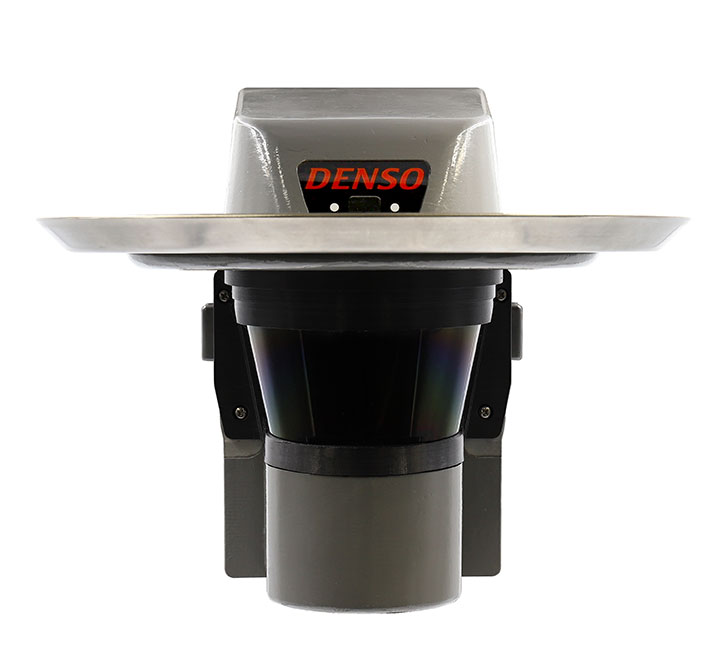
An OEM for security products needed reliable, intelligent IoT sensing technology for a perimeter airport security system. DENSO WAVE developed a LiDAR-camera combination that performed reliably in heavy rain and dense fog. The device also provided detailed detection with camera pan, tilt and zoom capability. The work culminated in:
- Outcome: More reliable monitoring on airport grounds
- Product differentiation: Innovative fog removal algorithm and detection in any level of light, including interference from direct sunlight
- Confirmation of DENSO WAVE’s Value: Expertise in LiDAR technology and expertise in environmental challenges
All three OEMs needed DENSO WAVE to complement their internal resources.
When to Partner with an ODM
You will want to consider whether an ODM can cost-effectively support your IoT device manufacturing or control development project. Here are some questions to consider:
- Do you need specialized expertise your team doesn’t currently have?
- Are you facing tight time-to-market deadlines?
- Do you require ruggedized, automotive-grade reliability?
- Are you concerned about component availability and supply chain risks?
- Do you want to focus on your core competencies while leveraging external innovation?
If you answered positively to any of these questions, partnering with DENSO WAVE can accelerate your success.
Accelerating Innovation Through Partnership
The explosive growth of industrial automation and control systems creates unprecedented opportunities for companies developing IoT sensing devices and controls. Expertise and speed determine success. Companies that leverage ODM partnerships will move faster, develop superior innovative products and capture market opportunities that slower competitors miss.
Few OEMs possess the multidisciplinary expertise, manufacturing capabilities and supply chain strength to address all the challenges efficiently. An ODM partnership with DENSO WAVE provides proven technical capabilities, automotive-grade reliability, Toyota Quality Control systems and supply chain power backed by a $50 billion parent company.
Contact us to discover how a partnership with DENSO WAVE can accelerate your innovation and compress your time to market.









Recent Comments