

Data centers power the digital world. They store sensitive customer records, financial data, intellectual property, healthcare information and government data. They also underpin cloud services, AI platforms and critical national infrastructure. When a data center is compromised, the consequences cascade quickly across essential services, including hospitals, banks, law enforcement and government agencies.
The data center market reflects this growing dependence on digital infrastructure. BCC Research reports that the global market reached approximately $418.2 billion in 2025 and forecasts growth to $691.6 billion by 2030, representing a compound annual growth rate of roughly 10.6%.1 Artificial intelligence workloads, hyperscale cloud expansion by providers such as AWS, Microsoft Azure and Google Cloud, the explosion of IoT data, 5G data and rapid digital transformation across every industry are all fueling this growth.
Today’s hyperscale and AI-focused data centers are enormous facilities. AI campuses from major technology companies now span 500,000 to over 1.5 million square feet and consume 100 to 500 or more megawatts of power. Protecting facilities of this scale demands a security approach that is equally advanced.
Two interconnected challenges define data center security.
- Physical Security – monitoring vast perimeters reliably under any environmental conditions.
- Access Control – multi-level access controls to prevent unauthorized personnel from accessing sensitive areas.
The superior innovative technology that the original design manufacturer (ODM), DENSO WAVE, has addresses both challenges directly, giving safety and security OEMs the technology, engineering depth and manufacturing resources to develop superior protection systems.
Data Center Security Challenge 1: Wide-Area Perimeter Detection
Large data center campuses pose a monitoring challenge that conventional camera-based systems struggle to address economically. Covering hundreds of thousands of square feet of outdoor perimeter with enough cameras to eliminate blind spots requires an enormous hardware investment and generates an overwhelming volume of video data for security operators to review. Weather compounds the difficulty. Rain, fog, snow and variable lighting degrade camera performance, jeopardizing reliable detection.
In order to be effective, a data center physical security system for a data center must accomplish several things simultaneously:
- Detect human and vehicle intrusions across a wide area in real time
- Operate reliably in heavy rain, dense fog, heavy snowfall, bright sunlight and complete darkness
- Determine the distance, size, direction and speed of any detected intruder
- Filter out false alarms caused by birds, animals, wind-blown debris and fallen leaves
- Define multiple detection zones with differentiated response actions
- Direct cameras to track and record intruders
- Alert on-site security personnel and, when necessary, local law enforcement
Solution 1: DENSO WAVE Zone D LiDAR Sensing Technology
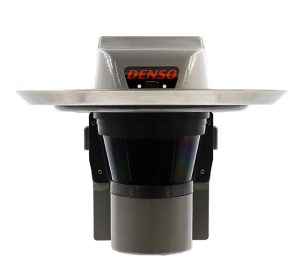
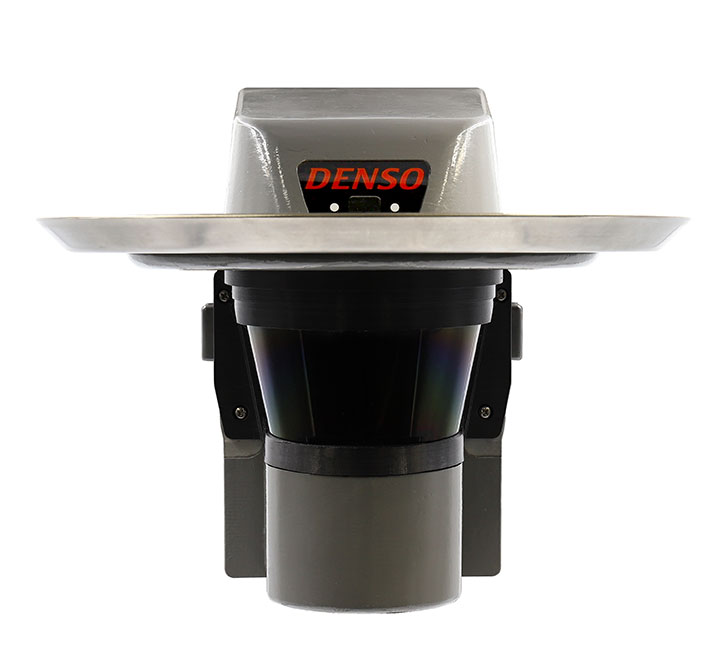
DENSO WAVE developed its Zone D LiDAR sensor line by applying automotive sensing technology originally created for Toyota’s advanced driver assistance and collision avoidance systems. This automotive heritage means technology has been engineered to the highest standards of reliability and performance in demanding real-world conditions.
The Zone D sensor uses a 905-nanometer infrared laser operating at Class 1 safety levels, meaning it poses no risk to human eyes. Each unit scans a 190-degree field at an angular resolution of 0.25 degrees, generating 780 measurement pulses per scan and taking 33 milliseconds. Detection coverage extends from a minimum radius of 100 feet to 300 feet or more depending on surface reflectance. The sensor simultaneously captures distance, object size, direction and speed of travel for every detected object.
- LiDAR All-Weather, All-Condition Reliability
DENSO WAVE’s proprietary time-A/D signal processing technology, combined with time-of-flight measurement, delivers a level of adverse-condition performance that competing products cannot match. In independent testing against benchmark competitors, DENSO WAVE sensors maintained reliable detection in rain falling at 50, 100 and 300 millimeters per hour and continued operating in dense fog conditions where competing devices lost measurement capability entirely. The system also functions normally under intense ambient illumination up to 100,000 Lux and across a wide operating temperature range of -20 to 60 °C. Additionally, the enclosure carries an IP66 dustproof and waterproof rating along with resistance to salt damage, making it fully suitable for outdoor deployment in coastal environments.
- Intelligent Object Filtering and Zone Management
False alarms waste security resources and erode operator confidence. DENSO WAVE’s built-in proprietary object detection algorithm filters out birds, small animals, wind-blown leaves and debris by evaluating the size of detected objects against user-configured target parameters. This means the system alerts only for humans and vehicles, not to the countless environmental events that trigger conventional beam-type sensors.
Furthermore, the Zone D sensor supports up to six independently configurable detection zones, each with user-defined shapes drawn freehand or with preset geometries. Each zone can trigger a distinct response action. Outer zones might activate warning lights or recorded audio messages directed at intruders. Intermediate zones can initiate video recording. Inner zones can lock doors, transmit alerts to security displays, and notify law enforcement.
- Integrated PTZ Camera Control DENSO WAVE integrates directly with pan-tilt-zoom (PTZ) cameras, using the precise positional data from the LiDAR sensor to point, focus and zoom the camera automatically onto a detected intruder. The camera zoom level adjusts dynamically based on the distance to the target, so security operators always receive a clear, usable image without manual intervention. This integration dramatically reduces the number of cameras needed to cover a large perimeter, lowering system cost while improving the quality and consistency of surveillance footage.
The LiDAR sensor can be mounted vertically for traditional perimeter coverage or horizontally to monitor fence lines across extended distances. In airport security applications, a horizontally mounted Zone D sensor can effectively cover large fence perimeters without overwhelming security staff with information. Data center security systems can apply the same approach for monitoring expansive campuses.
Data Center Security Challenge 2: Multi-Level Access Control
Perimeter security keeps unauthorized people away from data center grounds. Access control goes further, ensuring that only verified individuals can enter the facility and that each person’s access is limited precisely to the areas required by their role. Data centers typically enforce several distinct access tiers, from general staff areas to data halls, and from high-security server rooms to network operations centers.
Effective access control at this level requires more than a badge or a PIN. It requires fast, accurate identity verification that cannot be spoofed with stolen credentials or counterfeit identification. It also requires a mechanism that can be centrally updated and audited in its entirety.
Solution 2: DENSO WAVE Secure QR Code and Biometric Technology
DENSO WAVE, as the inventor of the QR code, brings deep expertise to access control applications. The company’s SQRC (Secure QR Code) technology encodes both public and private data within a single QR code. The public data layer handles standard identification functions, while the private layer, accessible only to authorized devices, provides access-level permissions and encrypted personal data. SQRC codes cannot be easily duplicated or altered, which eliminates the risk of credential forgery that plagues conventional badge systems.
For data center security applications, SQRC enables a tiered access model in which the same credential mechanism controls access at every level. A visitor might present a one-time SQRC code granting access only to a lobby. A contractor might hold a time-limited SQRC code permitting access to a specific area for a defined period. Permanent staff members receive SQRC credentials that encode their specific access permissions down to the individual room level.
DENSO WAVE complements SQRC technology with facial recognition biometric verification. Combining SQRC with facial recognition creates a multi-factor authentication system that is highly resistant to unauthorized access attempts. The facial recognition system verifies the physical presence of the credential holder, preventing badge sharing and defeating attempts to use stolen credentials.
The QR code reader and biometric hardware integrate with existing access control software platforms, simplifying system design for OEMs and reducing integration burden for end customers.
Partnering with DENSO WAVE: A Competitive Advantage for Security OEMs
DENSO WAVE, a company within the DENSO Corporation family, offers a combination of capabilities that few technology suppliers can match. The company’s LiDAR technology is based on automotive-grade engineering developed in partnership with one of the world’s largest vehicle manufacturers. Its QR code expertise comes from the team that invented the technology. Its manufacturing infrastructure, supply chain reliability and commitment to full product lifecycle support reflect more than 70 years of DENSO Corporation’s operational discipline.
For data center security OEMs developing data center protection systems, DENSO WAVE offers:
- Advanced LiDAR sensing that outperforms competitors in all-weather, all-lighting detection
- Intelligent object filtering that reduces false alarms
- Configurable multi-zone detection with differentiated response actions
- PTZ camera integration that reduces hardware costs and improves image quality
- SQRC access control with multi-factor biometric verification
- IC Card and palm vein recognition access control
- End-to-end engineering support from product definition through manufacturing and aftermarket
Data centers represent one of the most demanding and fastest-growing segments in the safety and security market. OEMs that can offer superior, integrated protection systems can capture a significant share of this expanding market. DENSO WAVE provides the technology and the partnership to make that possible.
Contact DENSO WAVE to explore how a development partnership can elevate your next data center security system. Visit DENSO WAVE ODM to learn more.
1Global Data Center Market. bcc Research. BCC Publishing: July 2025.

















Recent Comments