

How an ODM Can Enhance Your Product Portfolio More Cost-Effectively and More Quickly
Buildings are no longer just structures. They are intelligent, connected ecosystems that monitor energy use, anticipate occupant needs and optimize performance in real time. The global smart building controls market reached $141 billion in 2025 and is projected to surpass $554 billion by 20331. That expectation represents a very healthy compound annual growth rate of nearly 19%. For OEMs in the building controls space, the message is clear: the market offers substantial opportunity, and success requires immediate and sustained product development for delivery of the right products at the right time.
Winning in the smart controls market demands innovation at a pace most OEMs struggle to sustain. Developing next-generation building automation systems (BAS), HVAC controls and energy management systems require expertise across hardware, software, connectivity and cybersecurity — capabilities that few OEMs have totally in-house.
That’s where the right original design manufacturer (ODM) partner makes all the difference. The right ODM brings the technology, talent and proven processes to help OEMs bring sophisticated smart controls to market faster and more cost-effectively than if they were to develop all the smart controls alone.
What’s Driving the Smart Building Control Systems Revolution
Several converging forces are reshaping demand for smarter building controls and automation systems. These include:
- More intelligent, feature-rich controls: Modern HVAC controls and thermostats incorporate occupancy sensing, machine learning algorithms, multi-zone coordination and predictive maintenance — moving well beyond simple on/off switching.
- IoT connectivity: Building systems are now networked platforms that enable real-time monitoring, remote diagnostics and data-driven energy optimization across entire facilities.
- Lower power requirements: Energy efficiency is both a regulatory mandate and a market differentiator. Controls must minimize their own energy footprint while maximizing system performance.
- Cost efficiency: Facility owners and operators must reduce energy costs for maximum ROI. Smart controls deliver measurable savings through optimized energy consumption.
- Sustainability: Corporate carbon reduction commitments and tightening regulatory standards are accelerating the adoption of smarter building controls. Energy management systems that monitor, report and reduce consumption provide organizations with data to support meeting their sustainability goals.
- Advanced human-machine interfaces (HMIs): Occupants and facility managers expect intuitive touchscreens, smartphone integration and visually compelling interfaces. The dial thermostat is history.
- Cybersecurity: As building automation systems connect to the internet and enterprise networks, robust cybersecurity design has become a baseline expectation, not a premium feature.
- Home energy management systems (HEMS): Integrated platforms that coordinate HVAC, solar generation, EV charging, water heating and security represent the next frontier of residential controls.
Together, these trends are transforming building controls from simple mechanical components into intelligent, connected platforms that demand far more sophisticated engineering, software integration and system-level design expertise.
The Challenges OEMs Face in Developing Smart Building Control Systems
Building the next generation of smart controls for building automation systems demands expertise across an unusually wide range of technical disciplines: hardware design, custom silicon (ASICs), embedded firmware, wireless connectivity, cloud communication, mechanical packaging and cybersecurity.
- Internal resources: Few OEMs have deep capabilities across all these areas simultaneously, and most internal engineering teams are fully committed to supporting existing product lines.
- Time-to-market pressure: Customer preference and stiff competition punish slow movers. Extended development timelines mean lost revenue and ceded market share.
- Supply chain risk: Another layer of complexity that can bring development to a halt. Single-source component dependencies have proven especially costly amid persistent supply disruptions.
- Regulation and certification compliance: Meeting rigorous safety standards and regulatory certifications such as UL, FCC and Energy Star requires expertise and process discipline that stretches most teams even further.
Ultimately, these challenges are forcing companies to rethink how they develop advanced building control systems—seeking approaches that combine deep multidisciplinary expertise, faster development cycles and resilient supply chains to bring increasingly complex products to market successfully.
Future Trends in Smart Building Automation Systems and Building Control Systems
Building control systems are evolving rapidly as new technologies, energy requirements and user expectations reshape how buildings operate and interact with their occupants and the broader energy ecosystem.
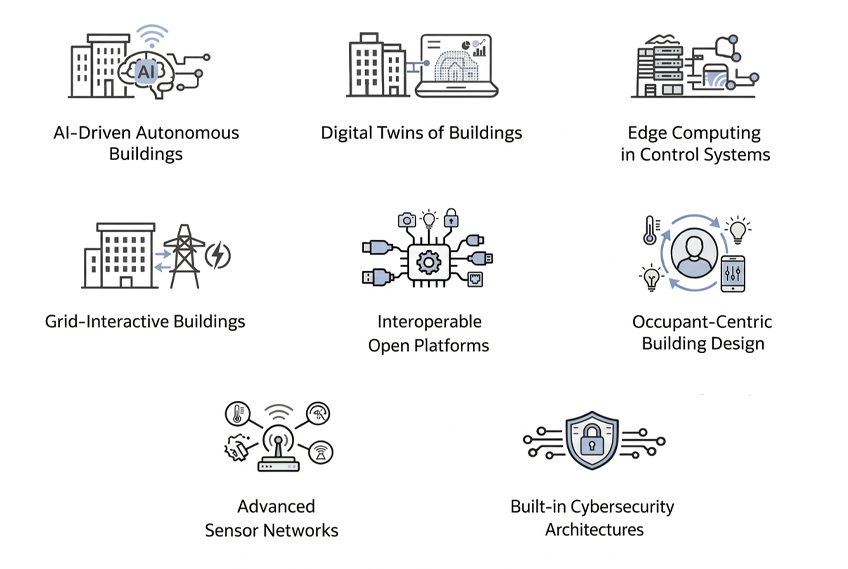
- AI-Driven autonomous buildings – Artificial intelligence will move building controls from reactive systems to self-optimizing environments. AI models will continuously learn occupancy patterns, weather impacts and equipment behavior to automatically adjust HVAC and lighting for comfort and energy efficiency.
- Digital twins of buildings – Digital twins—virtual models of buildings and their systems—will allow operators to simulate performance, detect inefficiencies and predict failures before they occur. This will improve maintenance planning and long-term energy optimization.
- Grid-interactive buildings – Buildings will increasingly interact with the electric grid. Controls will coordinate energy use to respond to energy pricing and grid demand, turning buildings into active participants in energy markets.
- Edge computing in control systems – Instead of sending all data to the cloud, building controllers will process information locally at the edge, enabling faster decision-making, improved reliability and better cybersecurity.
- Interoperable open platforms – Future systems will prioritize open protocols and platform architectures that allow different vendors’ devices and software to integrate seamlessly. This reduces vendor lock-in and enables flexible system upgrades.
- Occupant-centric building design – Controls will increasingly adapt to individual occupant preferences that personalize temperature, lighting and airflow.
- Advanced sensor networks – Next-generation sensors will measure air quality, occupancy, vibration, noise, and equipment health, providing richer data streams to improve predictive behavior.
- Built-in cybersecurity architectures – As building systems connect to enterprise networks and the cloud, secure device authentication, encrypted communication, and continuous monitoring will become standard design requirements.
As these innovations converge, building controls systems will play an increasingly central role in creating smarter, more efficient and more responsive built environments.
Bringing in an ODM Partner to Solve the Challenges
A capable ODM overcomes these barriers by delivering the full stack of development expertise an OEM needs without the cost or time required to build those capabilities in-house. An ODM is a full-service product development department that goes beyond just designing, an ODM is going to take every hassle off your hands from supply acquisition to logistics.
Imagine your company had a great idea for the next innovation in smart building control systems, but didn’t have the resources to make the connections to make it happen. This is where an ODM steps in and takes care of all aspects from conception down to getting it shelf-ready.
Why DENSO WAVE Is the Right ODM Partner for Smart Building Controls Systems
While a design house offering design services is a great start, the complexities of a fast-paced industry mean that new product development needs a more comprehensive solution. DENSO WAVE has a broader perspective and expertise that enables building controls OEMs to grow with new smart controls products while maintaining focus with their internal teams on existing product lines. DENSO WAVE offers a complete portfolio of services:
- Automotive-grade quality: As a subsidiary of DENSO Corporation — a Toyota Tier-1 supplier with $48 billion in revenue — DENSO WAVE engineers products to automotive durability and reliability standards. Those standards translate directly to building control applications that must perform dependably over long service lives.
- Toyota quality control systems: DENSO WAVE applies the same rigorous quality management methodologies used in automotive manufacturing, ensuring consistently high quality across every production run.
- Deep controls expertise: DENSO WAVE’s ODM division brings expertise in analog and digital electronics, custom ASIC development, sensor technology, network protocols and mechanical packaging.
- Cybersecurity and functional safety leadership: With more than 30 TÜV-certified functional safety engineers and deep experience with IEC and ISO safety standards, DENSO WAVE is a critical differentiator as building automation systems become more connected and more regulated.
- Supply chain strength: As part of a $50 billion enterprise with 211 consolidated subsidiaries and global procurement reach, DENSO WAVE provides partners with reliable, continuous component sourcing, a significant advantage in an era of persistent supply chain volatility
- End-to-end services: DENSO WAVE manages the complete product lifecycle from initial ideation through planning, development, production, logistics and ongoing support.
Proven Results: DENSO WAVE’s Impact
DENSO WAVE’s track record with building controls OEMs demonstrates what a true development partnership looks like. When an HVAC OEM wanted to bring thermostat development in-house under its own brand but lacked the internal engineering depth to execute, DENSO WAVE delivered more than a single product. It built a scalable platform architecture that enabled the OEM to launch a family of thermostats with progressively advanced capabilities. That partnership has now produced more than six product generations, with shared platform investments compressing development time and cost with every cycle.
On the residential side, DENSO WAVE developed an integrated home energy management system platform that enables OEMs to coordinate HVAC, solar generation, EV/EHV charging, door locks, water heating and security through a single intelligent controller connected to smartphones and the cloud. OEMs can license and build on this platform to enter the HEMS market without starting from nothing — dramatically reducing the investment required to compete in one of the fastest-growing segments of energy management2.

Partner with DENSO WAVE — Bring Your Vision to Market
The smart building control systems market is expanding rapidly and rewarding OEMs that deliver intelligent, connected and reliable products. Most OEMs face real resource and expertise constraints that slow development and increase risk. DENSO WAVE offers a proven, cost-effective path to market — combining automotive-grade engineering discipline, deep domain expertise and end-to-end ODM capability in every engagement.
Whether you need to develop a single smart thermostat, a complete HVAC controls platform or a fully integrated home energy management system, DENSO WAVE has the people, processes and technology to deliver results — faster and more reliably than proceeding without an ODM partner.
Visit us at originaldesignmanufacturer.com or contact us to start on the path to developing a product line of smart building controls.
1Grand View Research. (2025). Smart building market size & share, industry report, 2033. https://www.grandviewresearch.com/industry-analysis/global-smart-buildings-market
2Mordor Intelligence, “Energy Management Systems Market Report,” 2025 https://www.mordorintelligence.com/industry-reports/energy-management-systems-market
 Bob Coppenhaver
Leave a Reply